
The Last Supper — immersive flight
How to turn an instantly recognisable painting into a traversable space without losing the artwork.
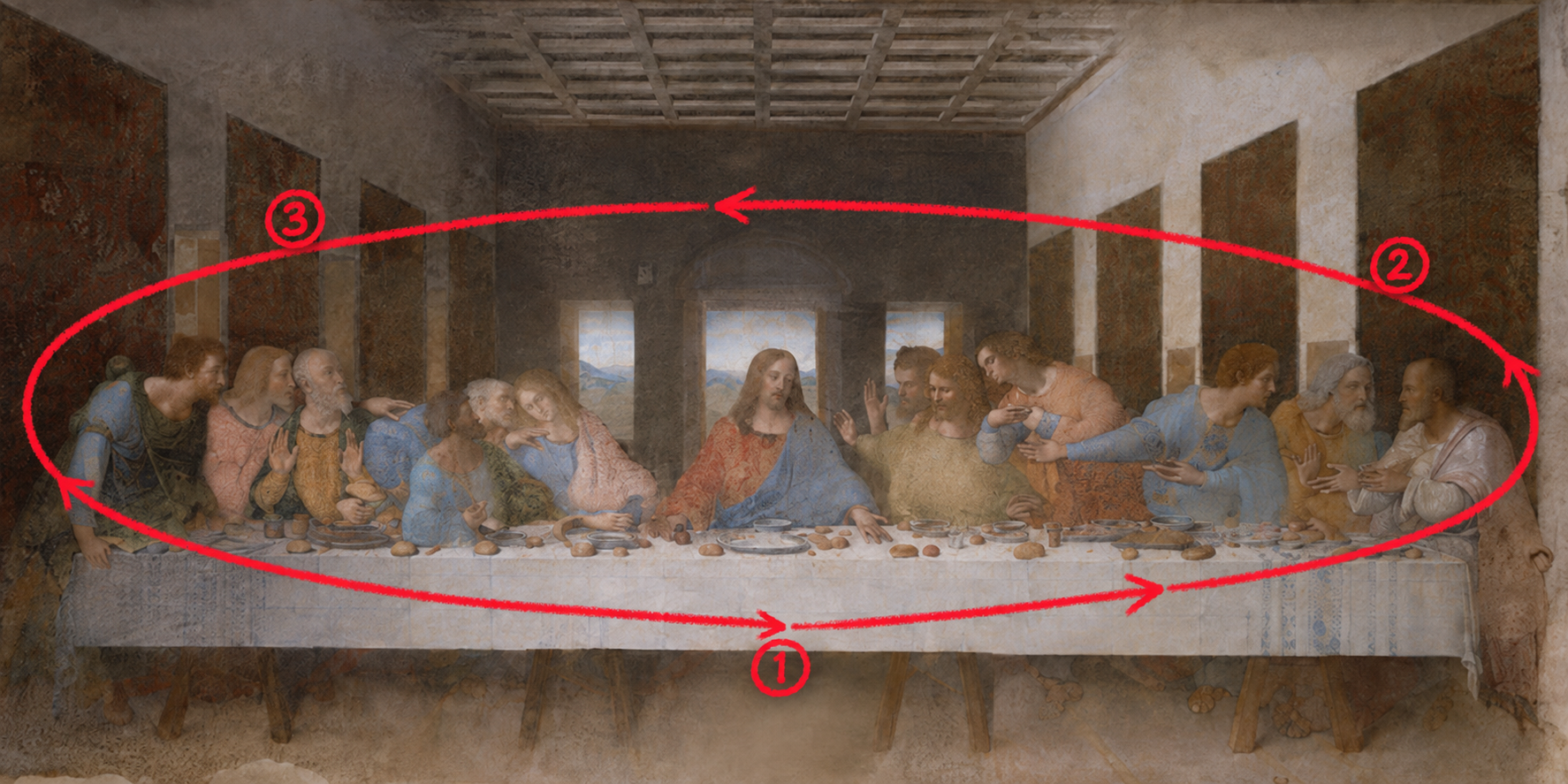
The idea is to keep The Last Supper immediately readable while giving the impression that the camera actually enters the refectory. The flight starts facing the composition, moves closer to Christ, circles around the table and the groups of apostles, then returns to the centre.
The goal is not to animate the characters heavily. It is to create depth through camera movement, parallax and changing perspective, while keeping the scene stable.
The second visual shows the flight path in red: it serves as a simple guide to understand the circulation logic in the image before writing the prompt.
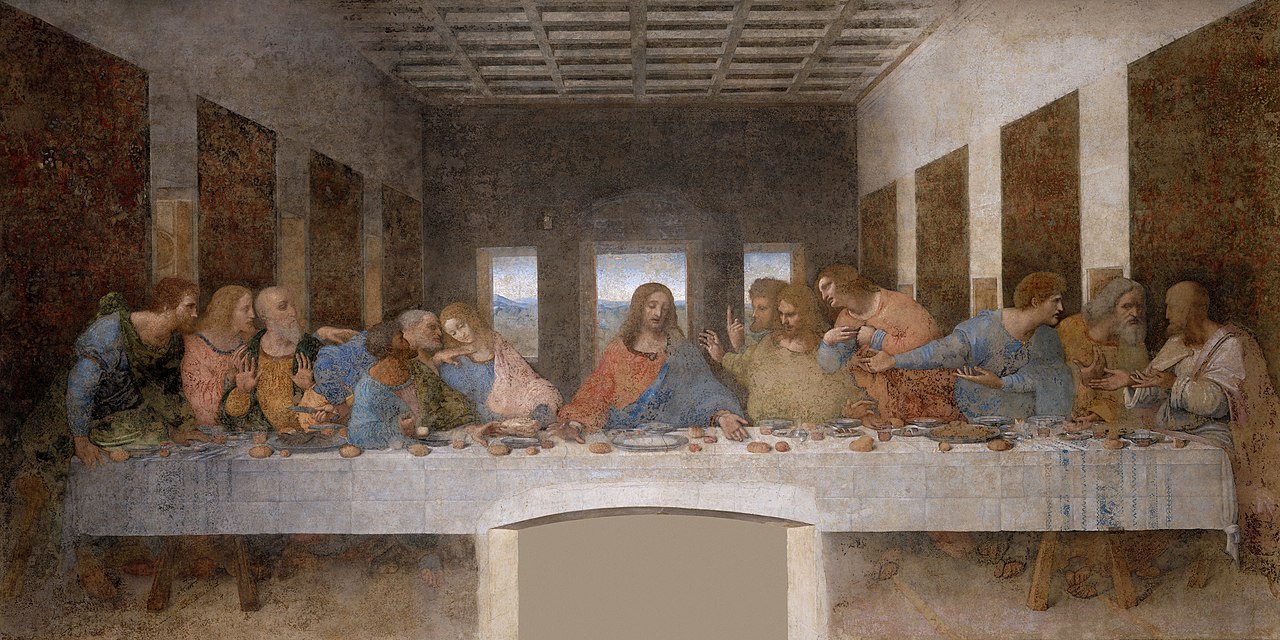
Use the horizontal reference image as the exact first frame. Preserve Leonardo da Vinci's original composition, character identities, poses, table, objects, architecture, color relationships and pictorial character. Do not redesign the scene, replace figures, add objects or modernize the painting.

Create one continuous 9-second immersive FPV-style camera flight with no cuts.

0.0–1.3 s: move forward from the original viewpoint, centered into the refectory, creating depth while keeping the full composition readable.

1.3–3.0 s: drift slightly left while pushing toward Christ, maintaining his identity and the surrounding apostles.

3.0–5.2 s: continue into a controlled clockwise arc around Christ, revealing spatial parallax without changing the arrangement of the figures.

5.2–6.8 s: fly low and close along the tabletop, passing the existing plates, bread, glasses and hands without inventing or duplicating objects.

6.8–8.0 s: continue behind the apostles on the right side, preserving faces, clothing, anatomy and their positions relative to the table.

8.0–9.0 s: make a final smooth arc from the far right back toward Christ, ending with him clearly readable as the visual anchor.

Keep human motion extremely restrained: subtle breathing, occasional natural blinking and minimal fabric response only. Allow a faint sense of dust in the air. Maintain continuous camera motion from the first frame. No frozen tableau, no morphing, no duplicate people, no new architecture, no text, no transition effect and no cut.
Artwork: Leonardo da Vinci, The Last Supper. Reference image: Wikimedia Commons, “The Last Supper - Leonardo Da Vinci - High Resolution 32x16.jpg” — original artwork public domain; digital reproduction CC BY-SA 4.0. Camera path: Mycélium × Strativarius, created for this tutorial from the documented workflow.